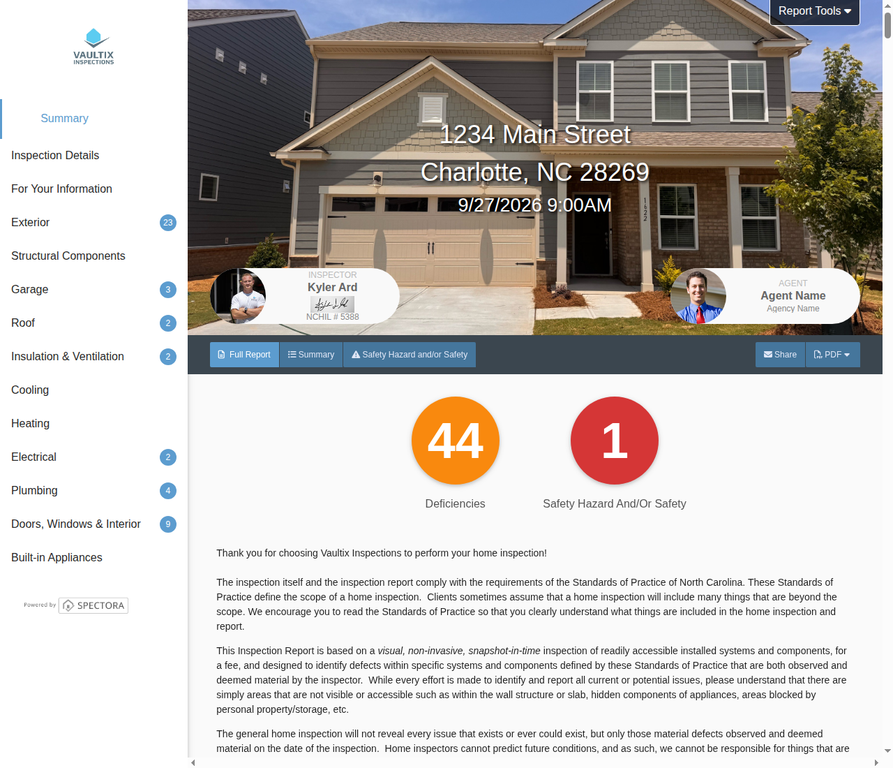
How to review a sample report
Open the Vaultix Spectora directory in a new tab and select one of the available sample reports. Begin with the navigation and summary so you understand how the document is organized, then move through the full report rather than stopping at the first list of findings. A sample is most useful as a demonstration of structure, readability, photographs, and the level of explanatory detail a client can expect.
Look for the relationship between a written observation and its supporting media. The report should help a reader locate the area, understand what was visible during the inspection, and see whether the inspector recommended monitoring, maintenance, repair, or evaluation by another qualified professional. The exact categories and number of findings will vary because every property and inspection scope is different.
What an inspection report can communicate
A well-organized report turns on-site observations into a document that remains useful after the walkthrough. Photographs can provide location and visual context. Clear section labels make it easier to return to a roof, exterior, structure, plumbing, electrical, heating, cooling, interior, or appliance observation. Written explanations help distinguish the observed condition from a possible next step.
The report can also support conversations among buyers, sellers, owners, agents, builders, and qualified contractors. It does not decide which repairs must be made or what a party should negotiate. Those decisions depend on the transaction, applicable agreements, professional advice, and the priorities of the people involved. The report’s role is to document and explain what was observed within the inspection’s scope.
What a sample cannot tell you
A sample report is not a promise that another property will have the same systems, conditions, findings, photographs, or page count. It cannot demonstrate conditions that were concealed, inaccessible, unsafe to inspect, outside the agreed scope, or not present at the sample property. It also should not be used as a substitute for reviewing the report prepared for your own property.
Specialized services may produce different information from a general home inspection. Radon measurements, laboratory water results, environmental sampling, indoor-air-quality work, and WDIR documentation each follow their own service scope and reporting needs. Review the relevant service page and confirm details with Vaultix before scheduling if you need a focused measurement, sample, or transaction document.
Questions to ask after reading
Notice whether the sample’s language is understandable to someone who was not standing beside the inspector. Consider whether photographs make locations clear and whether recommendations identify an appropriate type of follow-up without making unsupported promises. If a report term, category, limitation, or recommendation is unfamiliar, ask how Vaultix explains it to clients.
When you are ready to schedule, provide accurate property and contact details and choose the service that fits the decision in front of you. If you are still comparing a general inspection with focused testing or sampling, call, text, or email before submitting the request. Clarifying scope at the beginning makes the later report easier to understand and use.